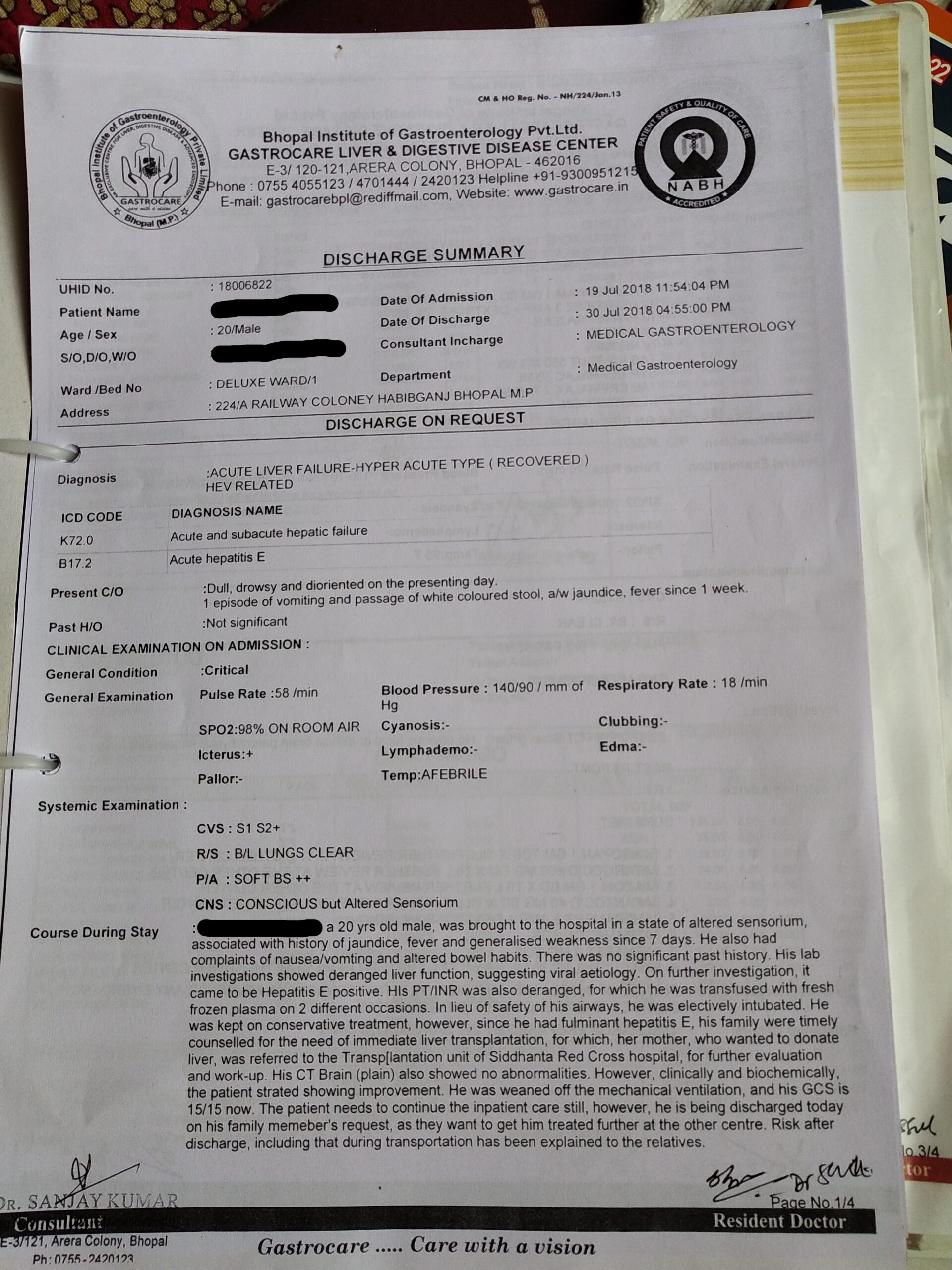
20 वर्षीय युवक रसाहार केन्द्र क्लिनिक में बढ़े हुए यकृत (Liver) पैरामीटर और हेपेटाइटिस E से पीड़ित होकर आए। उन्हें अस्पताल में भर्ती किया गया, जहाँ चिकित्सकों की टीम ने बताया कि उनका रोग अब असाध्य है और यकृत प्रत्यारोपण (Liver Transplant) अनिवार्य है।
मुख्य लेखक, जो रसाहार उपचार के परामर्शदाता हैं, ने सभी एलोपैथिक दवाएँ तुरंत बंद करने और रसाहार उपचार शुरू करने का परामर्श दिया। साथ ही कठोर आहार-विहार (Diet–Lifestyle) और नाड़ी शुद्धि प्राणायाम (20 राउंड, दिन में दो बार) करने को कहा। उन्हें मात्र उबली लौकी और निर्धारित रसाहार लेने की अनुमति दी गई।
यह कठोर नियम तब तक जारी रहा जब तक उनका बिलीरुबिन (Bilirubin) स्तर 5 से नीचे नहीं आ गया। उपचार शुरू करने के 34 दिन बाद उन्होंने गेहूं के जवारे का रस लेने से मना कर दिया क्योंकि उन्हें अच्छा नहीं लग रहा था। उपचार के 42वें दिन बिलीरुबिन (Bilirubin) घटकर 4.2 हो गया। फिर भी गिल्बर्ट सिंड्रोम होने का खतरा बना रहा।
उन्हें पर्याप्त फल और सलाद, साथ ही ज्वार की एक रोटी, उबली हुई सब्जियाँ और चावल दिन में दो बार लेने को कहा गया।
49वें दिन, जब बिलीरुबिन 2.8 तक घट गया, उन्हें मूंग दाल और गेहूँ की रोटी अधिक मात्रा में लेने का परामर्श दिया।
63वें दिन उन्हें अन्य अनाज और सूखे मेवे (लेकिन मेवे/नट्स नहीं) खाने की अनुमति दी गई।
84वें दिन के बाद उन्हें देसी गाय का घी (कम वसा होने के कारण) लेने की अनुमति दी गई।
इसके बाद उन्हें सामान्य जीवनचर्या अपनाने और शरीर की आवश्यकता अनुसार पूर्ण भोजन करने का परामर्श दिया। उन्होंने 8 रोटियाँ, पर्याप्त सब्जियाँ और दाल देसी गाय के घी में पकाकर खाना शुरू किया।
साथ ही उन्होंने नाड़ी शुद्धि प्राणायाम (20 राउंड, दिन में दो बार), सूक्ष्म व्यायाम और 2 किलोमीटर पैदल चलना शुरू किया। बाद में उन्हें धीरे-धीरे अधिक आसन और सूर्य नमस्कार की संख्या बढ़ाने का परामर्श दिया। किसी विशेष आसन की अनुशंसा नहीं की गई।
उनका रसाहार उपचार 50वें दिन से कम कर दिया गया।
चर्चा के बिंदु
रोग-स्थिति (Pathologies) रसाहार शुरू करने के दूसरे दिन से ही सुधारने लगी।
रोगी ने कुल 86 दिनों तक रसाहार लिया।
उन्होंने 42 दिनों तक मात्र उबली लौकी का भोजन लिया। इस दौरान बिना किसी प्रोटीन सेवन के भी उसका प्रोटीन स्तर लगभग समान बना रहा।
रसाहार उपचार एलोपैथिक दवाओं और अस्पताल में भर्ती की तुलना में बहुत कम खर्चीला है।
अस्पताल में 23 दिनों के खर्च लगभग 120000 रुपए हुए।
लिवर ट्रांसप्लांट होता तो 25 लाख रुपए खर्च होते।
जबकि पूरे रसाहार उपचार का खर्च केवल ₹8726/- रहा।
A 20-year-old young man reported to Rasahara kendra clinic with increased Liver parameters, suffering from Hepatitis E. He was hospitalized and a team of doctors from that hospital announced that his disease is now incurable and transplant of Liver is unavoidable. Main author who is advisor of Rasahara treatment advised to stop all Allopathic medicines immediately and asked to start Rasahara with strict Ahara-Vihara and practicing Nadi shuddhi Pranayama 20 round twice daily. He was advised to take the only food ‘Bottle gourd’ including with his prescribed Rasahara. This strict regime was continued till his Bilirubin came down bellow 5. It was reduced to 4.2 42nd day of treatment. Still there was threat of acquiring Gilbert syndrome. He was advised to take Plenty of fruits and salads, one Chapati of Jovar with boiled vegetables including with rice twice daily. He was advised to take Moong Dal and Wheat Chapati in increased quantity on 49th day after coming down his Bilirubin to 2.8. On 63rd day he was advised to eat all other serials and dry fruits but not nuts. He was allowed to eat Ghee of Indian cow (because of its low fat) only after 84th day of treatment. He was suggested to start his normal routine of life and to eat his full meal daily as his body’s requirement. He started eating 8 Chapaties with plenty of Vegetables and Dal fried with Indian cow’s Ghee. He started practicing warming up exercise with Nadi shuddhi Pranayama 20 round twice daily followed by 2 Kilometers walk. He was then advised to increase more Asanas with increasing number of Surya Namaskara as his body allows. He was not suggested any specific Asanas. His Rasahara was reduced from 50th day of treatment. He has not taken Wheatgrass after 34 days despite of advice because of his unwillingness.
Points for discussion
Pathologies started improving from 2nd day of Rasahara.
Patient took Rasahara for 86 days.
He ate the only food ‘Bottle gourd’ for 36 days. His Protein level kept almost at same level without taking any Protein intake.
Rasahara is very less expensive compared to Allopathic medicine and hospitalization. His hospital expenses were above 1.2 Lakhs Rs. in 23 days compared to Rasahara which 8726/- in all.
If there was a liver transplant, it would have cost Rs 25 lakh.
Ayurvedic Routine, Yoga, Diet, and Home Remedies for Diabetes and Related Health Issues: A Case Study
प्रस्तावना
आरोग्य योग एवं रसाहार शोध समिति के माध्यम से गत 18 वर्षों से सतत् दिए जा रहे ताजा रसों के प्रभाव अनेक मधुमेह रोगियों पर देखे गए हैं। उनके अनुभव के फीडबैक भी सतत् मिलते रहे हैं। किडनी प्रभावित हो चुके मधुमेह रोगी का उपचार ताजा रसों से करना अभी तक कल्पना से परे था। किंतु इस अध्ययन के कारण ताज़ा रसों की विश्वसनीयता एक बार और स्थापित हुई है। यूं तो सभी शोध अध्ययन साइंटिफिक जर्नल में प्रकाशित होते हैं, परंतु रसाहार सम्बन्धी अध्ययन का शोध पत्र मैंने पब्लिक डोमेन में डालना अधिक आवश्यक समझा। ताकि सामान्य जन रसाहार के महत्व को समझ सकें और रोग की कठिनतम अवस्था में भी आत्मनिर्भर रह सकें। नियमित जांचों के माध्यम से रोग की अवस्था पर कड़ी निगरानी रखी जा सकती है। रोगी का दृढ़ निश्चय, ईश्वर पर पूर्ण आस्था, दिनचर्या एवं ऋतुचर्या पालन आहार नियमों का पालन तथा नियमित योग के कारण उत्पन्न सकारात्मक रोग को विकृत होने ही नहीं देते।
Preface
Through the Aarogya Yoga and Rasahara Shodha Samiti, the effects of fresh juice therapy (Rasahara) have been continuously observed on many diabetes patients for the past 18 years. Feedback from these patients has also been consistently received. Until now, treating diabetic patients with kidney complications using fresh juices was beyond imagination. However, this study has once again established the reliability of fresh juices (Rasahara). While most research studies are published in scientific journals, I deemed it essential to place this research on juice therapy in the public domain to allow people to understand its importance and self-manage their health even in severe conditions. Regular monitoring of the disease can help keep its progression under control. The patient’s determination, complete faith in God, adherence to daily routines and seasonal guidelines, dietary discipline, and regular yoga help prevent the disease from worsening.
उद्देश्य
अध्ययन से यह सुनिश्चित करना है कि, मधुमेह रोगी के लिए शर्करा वृद्धि को रोकने हेतु आयुर्वेद अनुसार बताई गई दिनचर्या आहार नियम ऋतुचर्या तथा सोने और जागने का समय आदि का ध्यान रखना अत्यंत आवश्यक है। अर्थात भोजन निश्चित समय पर निश्चित मात्रा में हो निद्रा न तो बहुत अधिक हो न ही बहुत कम हो। उसका समय भी सही हो, सूर्योदय पर उठ जाएं, और रात को भी जल्दी सोएं, दोपहर निद्रा न करें। भोजन टुकड़ों में न करके सही समय पर दिन में 2 बार करना चाहिए।
Objective
The objective of this study is to demonstrate that, according to Ayurveda, maintaining routines, dietary rules, seasonal guidelines, and fixed sleep and wake times are crucial for diabetes patients to control blood sugar levels. Meals should be at fixed times and in fixed quantities, sleep should neither be excessive nor insufficient, and the timing of sleep should align with nature. The patient should wake up at sunrise and sleep early at night, avoiding daytime naps. Meals should be limited to two proper sittings during the day rather than eating in fragments.
पृष्ठभूमि
बढ़ते भोग वाद एवं श्रम रहित जीवन के कारण पिछले कुछ वर्षों से मधुमेह तीव्र गति से संसार में अपने पांव जमा रहा है (3)। कोविड-19 महामारी के प्रारंभ में अत्यंत तनावग्रस्त स्थितियां (4) तथा कोरोना हेतु दी जाने वाली औषधि के कारण भी अनेक रोगियों की शर्करा बढ़ने की स्थितियां बनी हैं (5)। कोविड महामारी में अस्पतालों और चिकित्सा कर्मियों पर बढ़ते बोझ, समय की कमी और कार्यकर्ताओं की कमी को देखते हुए चिकित्सा के क्षेत्र में अन्य उपचार पद्धतियों को बढ़ावा देना अत्यधिक आवश्यक हो गया है। संसार के प्रत्येक व्यक्ति को स्वास्थ्य संबंधी विषयों पर स्वावलंबी होना भी अति आवश्यक हो गया है। इस हेतु आयुर्वेद एवं भारतीय चिकित्सा पद्धतियों का ज्ञान सबको होना चाहिए। योग को अपने दैनिक जीवन की दिनचर्या में स्थान देने से मनुष्य तनाव से मुक्त एवं रोग रहित रह सकते हैं (6)।
आयुर्वेद में दिनचर्या पालन का महत्व सबसे अधिक है। स्वस्थ वृत्त (7) आयुर्वेद का वह भाग है, जिसमें मनुष्य को प्रातः उठने से लेकर रात्रि सोने तक की पूरी दिनचर्या को किस प्रकार रखा जाए, यह सिखाया जाता है। इसी प्रकार ऋतुचर्या में किस ऋतु में कैसे रहना चाहिए, क्या खाना पीना चाहिए, क्या नहीं खाना पीना चाहिए, यह सब बताया जाता है। साथ ही आयुर्वेद में रात्रिचर्या का भी वर्णन मिलता है, जिसमें सोने का स्थान, दिशा समय इत्यादि अनेक बातों का विस्तार से वर्णन है। दिनचर्या में भोजन के समय भी निश्चित करके बताए गए हैं। योगरत्नाकर में दिए गए 1 श्लोक के अनुसार (8) व्यक्ति का दोपहर भोजन सूर्योदय के 3 घंटे बाद से लेकर 6 घंटे बाद तक के बीच में होना चाहिए। इससे पूर्व किसी को अन्न नहीं लेना चाहिए। रसाहार उपचार के अंतर्गत विभिन्न वनस्पतियों के पेड़ों के पत्तियां तने, फूल, फल अथवा जड़ों का ताजा रस बनाकर उपचार हेतु उपयोग में लाया जाता है। इसके उपयोग का समय प्रातः काल अर्थात दिन का पहला पहर होता है (9)। भारत के भोपाल शहर में चार रसाहार केंद्रों के माध्यम से पिछले 18 वर्षों से सफलतापूर्वक रसाहार उपचार का उपयोग 10000 से अधिक लोगों पर किया जा चुका है। रोग की अवस्था में रोगी अथवा स्वस्थ अवस्था में कोई भी इसके नियमित सेवन से शरीर के सभी अंगों को पोषण मिलता है, साथ ही यह रस एंटीऑक्सीडेंट होने के कारण तथा विभिन्न प्रकार के मलों का शोधन करने का गुण रखने के कारण शरीर को शुद्ध भी बनाते हैं।
Background
Due to an increasingly indulgent and sedentary lifestyle, diabetes has rapidly spread worldwide in recent years. The stress and medications during the COVID-19 pandemic have further exacerbated this issue for many patients. With the rising burden on hospitals and healthcare workers during the pandemic, promoting alternative treatment methods became a necessity. Self-reliance in health management has become essential for everyone. Knowledge of Ayurveda and Indian medical practices can aid in this. Including yoga in daily life helps relieve stress and maintain health.
In Ayurveda, the importance of daily routines is paramount. The “Swasthavritta” (code of health) teaches how to manage one’s daily activities from morning to night. Seasonal routines (“Ritucharya”) guide what to eat and avoid during specific seasons. Additionally, the night routine (“Ratricharya”) provides guidance on sleeping arrangements, directions, and times. Specific meal timings are recommended. For example, “Yogaratnakar” suggests lunch should be taken three to six hours after sunrise, and no food should be consumed before that.
Juice therapy (Rasahara) uses fresh juices from various plants’ leaves, stems, flowers, fruits, or roots for treatment. The ideal time for consuming these juices is the early morning. Over the past 18 years, juice therapy has been successfully administered to over 10,000 individuals at four centers in Bhopal, India. Regular intake of these juices nourishes all body parts, purifies the body due to their antioxidant properties, and removes toxins.
महर्षि पतंजलि के बताए अनुसार यह 4 सूत्र (10, 11, 12, 13) अत्यंत महत्वपूर्ण एवं ध्यान रखने योग्य हैं-
According to Maharishi Patanjali, these 4 sutras (10, 11, 12, 13) are very important and worth keeping in mind-
अनित्य पदार्थों में नित्यता देखना, अशुद्ध पदार्थों में शुद्धता देखना, दुःख को सुख समझना और जड़ पदार्थों को चेतन जानना यही अविद्या का प्रमुख लक्षण है। यदि कोई शरीर को अनित्य समझकर तदनुरूप भावनात्मक एवं क्रियात्मक आचरण नहीं करता है, वह तो अत्यंत घनघोर अविद्या रूपी क्लेश से ग्रसित है, ऐसा समझना चाहिए।
Ignorance is taking the non-eternal, the impure, the painful, and the non-Self, as the eternal, the pure, the pleasant, and the Atman or Self respectively.
सुखानुशयी रागः (PYS 2.7)
Attachment is that which dwells upon pleasure.
जब कभी भी हम किसी भी सुख को भोगते हैं तो भोगने के बाद हमारे अंतःकरण (मन-बुद्धि-चित्त-अहंकार) में उस सुख और जिन साधनों से हमें सुख प्राप्त हुआ था उनके प्रति पुनः भोग करने की जो इच्छा है, वह इच्छा विशेष या लोभ विशेष को राग नाम का क्लेश कहते हैं।
ततः क्षीयते प्रकाशावरणम् (PYS 2.52)
From that, the covering over the inner light is removed.
प्राणायाम के सतत अभ्यास से एक ओर शरीर की शुद्धि होती है वहीँ दूसरी ओर मन का की मलिनता भी धुलती जाती है । तन और मन के सभी विकारों का नाश होने से बुद्धि में भी निर्मलता आती है । बुद्धि में स्वयं को अलग और पुरुष (जीवात्मा) को अलग देखने की क्षमता बढ़ती जाती है । पुरुष और बुद्धि का पृथक पृथक ज्ञान न हो पाना ही आवरण है और इसी आवरण का नाश प्राणायाम के द्वारा होता है ।
अतः केवल आसन प्राणायाम को ही योग न समझकर योग का वास्तविक अर्थ समझ कर उसे व्यवहार में लाना ही मनुष्य को तनाव रहित तथा उसके शरीर को रोग रहित बनाता है। प्रस्तुत अध्ययन में बताए गए रोगी के उपचार की दिशा इन्हीं बिंदुओं को ध्यान में रखकर की गई।
Continuous practice of Pranayama on one hand purifies the body and on the other hand the impurities of the mind are also washed away. The destruction of all the disorders of body and mind also brings purity in the intellect. The ability to see oneself as separate and the Purusha (soul) as separate increases in the intellect. Not being able to have separate knowledge of Purusha and intellect is the covering and this covering is destroyed by Pranayama.
अध्ययन विधि
रसाहार केंद्र में आने से पूर्व रोगी की स्थिति
27 वर्षों से मधुमेह रोगी; फैटी लीवर; गर्भाशय का आकार बढ़ा हुआ, मासिक अधिक; 2 वर्ष से उच्च रक्तचाप, किडनी की समस्याएं; दो माह से कीटो एसिडोसिस, उंगलियों में दर्द, कब्जियत, मल या मूत्र खुलकर नहीं आना, पेट में भारीपन, रात को नींद न आना, सुबह उठने की इच्छा न होना, खर्राटे, गैस, सुस्ती अधिक।
Diabetic patient for 27 years; fatty liver; Enlargement of uterus, heavy menstruation; High blood pressure, kidney problems from 2 years; Keto acidosis since two months, pain in fingers, constipation, inability to pass stool or urine, heaviness in the stomach, sleeplessness at night, not willing to get up in the morning, snoring, gas, lethargy, etc. Initial Condition of the Patient. In addition to diabetes and high blood pressure, 17 tablets of insulin four times a day (5+5+5+10)
मधुमेह एवं उच्च रक्तचाप के अतिरिक्त 17 टैबलेट चार बार इंसुलिन (5+5+5+10)
सुबह 9:00 बजे नाश्ता, दोपहर 2:00 बजे भोजन, रात 9:00 बजे दूसरा भोजन
Breakfast at 9:00 am, Lunch at 2:00 pm, Second meal at 9:00 pm
प्रातः 5:00 बजे जागरण रात्रि जब नींद आए 11 या 12:00 बजे के बाद निद्रा
Waking up at 5:00 in the morning if had sound sleep at night after 11 or 12:00 o’clock
प्रतिदिन आधे से एक घंटा आसन एवं कुछ मात्रा में प्राणायाम
Half to one hour of asana and a little of of pranayama every day.
ध्यान का प्रयास करने पर नींद आना
Falling asleep while trying to meditate.
रोग की विकृति के कारण उत्पन्न अत्यधिक तनाव पूर्ण स्थिति
Excessive stressful condition caused by the pathology of the disease.
रोगी ने जब अध्ययन कर्ता को अपनी समस्याओं की जानकारी दी, तब उन्हें कम से कम 20 दिनों के लिए रसाहार केन्द्र में आने को कहा गया। जिस दिन वह रसाहार केन्द्र में आई उनकी सभी सामान्य और आवश्यक चिकित्सकीय जांचें की गईं।
When the subject informed the Rasahara consultant about her problems, she was asked to come to the Rasahara Center for at least 20 days. All her usual and necessary medical check-ups were done on the day, she came to the Rasahara Kendra.
उन्हें प्रातः उठने से लेकर रात्रि सोने तक की एक दिनचर्या बना कर दी गई, जो तालिका क्रमांक तीन में दिखाई गई है। प्रातः योग के अंतर्गत उन्हें वही योग करते रहने के लिए कहा गया, जो वह पूर्व से करती आई हैं। लेकिन पूर्व में वे नियमित नहीं थे, अब उन्हें नियमित रूप से करने को कहा गया। तालिका क्रमांक 4 में उनके द्वारा किए जाने वाले योग, आसन तथा प्राणायाम बताए गए हैं।
She was given a daily routine from waking up in the morning till sleeping at night, which is shown in table number 3. In morning yoga, she was asked to continue doing the same yoga which she had been doing earlier. But earlier it was not regular, now she was asked to do it regularly.
तालिका क्रमांक 4 (Table No. 4):
क्रमांक
आसन/प्राणायाम (Asana/Pranayama)
स्थिरता का समय या चक्र (Time of maintaining or cycle)
1
सूक्ष्म व्यायाम (Sukshma Vyayama)
10 मिनट (10 min)
2
कपालभाति (Kapalabhati)
360
3
विपरीतकरणी (20 दीर्घश्वास के साथ) (Viparitakarani)
10 मिनट (10 min)
4
सूर्य नमस्कार (Suryanamskara)
2 चक्र (2 Cycles)
5
पवनमुक्तासन (Pavanamuktasana)
1 मिनट (1 min)
6
भुजंगासन (Bhujangasana)
1 मिनट (1 min)
7
शलभासन (Shalabhasana)
1 मिनट (1 min)
8
मर्कटासन (Markatasana)
1 मिनट (1 min)
9
वक्रासन (Vakrasana)
1 मिनट (1 min)
10
उष्ट्रासन (Ushtrasana)
1 मिनट (1 min)
11
ताड़ासन (Tadasana)
1 मिनट (1 min)
12
तिर्यक ताड़ासन (Tiryaka Tadasana)
1 मिनट (1 min)
13
कटिचक्रासन (Katichakrasana)
1 मिनट (1 min)
14
शवासन (Shavasana)
5 मिनट (5 min)
15
अनुलोम-विलोम (Anuloma-Viloma)
20 चक्र (20 Cycles)
16
ओंकार (Omkara)
20 चक्र (20 Cycles)
आवर्तन ध्यान (Cyclic meditation)
इसके अतिरिक्त उन्हें प्रतिदिन दोपहर भोजन के 2 घंटे बाद तथा रात्रि भोजन के 2 घंटे बाद अथवा सोने से पूर्व आवर्तन ध्यान (14) करने के लिए कहा गया। आवर्तन ध्यान एक 35 मिनट का शिथिलीकरण योगाभ्यास है, जो तालिका क्रमांक 5 में दिया गया है। अत्यधिक तनाव पूर्ण स्थिति का स्वप्रबंधन, यह विशिष्ट योगाभ्यास स्वामी विवेकानंद योग अनुसंधान संस्थान बेंगलुरु द्वारा तैयार किया गया है। जब तनाव अत्यधिक बढ़ जाता है, तो वह हमारे दैनिक कार्यों को प्रभावित करता है। इसमें तनाव की स्थिति से स्वयं को बाहर निकालने का प्रयास किया जाता है।
Apart from this, she was asked to do Cyclic meditation (14); 2 hours after lunch and 2 hours after dinner or before sleeping. Cyclic Meditation is a 35 minute relaxation yoga practice, which is given in Table No. 5. It is self-management of highly stressful situations, This specific yoga practice has been prepared by Swami Vivekananda Yoga Research Institute, Bengaluru. When stress becomes excessive, it affects our daily activities. In this practice, an attempt is made to get oneself out of the situation of stress.
आवर्तन ध्यान का योगाभ्यास एक श्लोक से प्रारंभ होता है। जिसे आदि शंकराचार्य द्वारा लिखी गई मांडूक्य उपनिषद् की टीका में लिखित एक कारिका से लिया गया है-
The yoga practice of Cyclic meditation starts with a verse. Which is taken from a Karika written in the commentary of Mandukya Upanishad written by Adi Shankaracharya.
अर्थ – शरीर की संपूर्ण स्थिर अवस्था में, जब चित्त की की गहराइयों में पड़े विकार बाहर आकर हमें विचलित करने का प्रयास करते हैं। तब ईश्वर से प्रार्थना है कि, ऐसी स्थिति में हम उन विकारों को समझ कर शांत कर सकें। ताकि वह हमें पुनः विचलित न करें।
In the state of oblivion, awaken the mind. When agitated, pacify it; in between the mind. If the mind has reached the state of perfect equilibrium, then do not disturb it again.
तालिका क्रमांक 5 (Table No. 5): आवर्तन ध्यान (Cyclic meditation)
दीर्घ शिथिलीकरण 6 मिनिट, विभागीय (DRT Deep relaxation technique)
लेट कर (In Shavasana)
10
शांति मंत्र (Closing prayer)
बैठ कर (Sitting Posture)
भोजन (Lunch and Dinner)
उन्हें दोनों समय भोजन के अंतर्गत दोपहर भोजन सामान्य ही रखा गया, परंतु तले हुए पदार्थ सामिष अथवा मीठे पदार्थ प्रतिबंधित रखे गए। रात्रि भोजन थोड़ा प्रतिबंधित रखा गया जिसके अंतर्गत किसी एक अनाज के साथ सब्जियां अथवा सूप दिया गया। दूध पीने की उनकी स्वयं की इच्छा नहीं होने के कारण उन्हें दूध नहीं दिया गया।
Lunch was kept as normal during both the meals, but fried foods, sweets or Non-veg were banned. Dinner was somewhat restricted, consisting of vegetables or soup along with one grain. She was not given milk because she was not willing to drink it.
रसाहार
रसाहार के अंतर्गत प्रातः काल उठते ही सबसे पहले नींबू पानी दो चम्मच शहद एवं सेंधा नमक के साथ सोंठ भी डाल कर दिया गया (15)। इसके साथ उन्हें एक चम्मच अजवाइन चूर्ण (16) प्रतिदिन खाने को कहा गया। दूसरे रस के रूप में उन्हें गोखरू (17), पुनर्नवा(18), अपामार्ग(19), अश्वगंधा(20) एवं गिलोय(21) का रस दिया गया। दूसरे रस के बाद अल्पाहार के रूप में उन्हें प्रतिदिन दो अंजीर (22) एवं 20 मुनक्के के दाने (23) जो कि रात्रि में भिगोकर रखे जाते थे, दिये गये। सायंकाल 5:00 बजे उन्हें तीसरे रस के रूप में मधुनाशक अर्थात अडूसा (24), गिलोय, गुड़मार (25), बेलपत्र (26), मीठी नीम (27), ग्वारपाठा (28) तथा हल्दी (29) का रस दिया गया। तीसरे रस के रूप में उन्हें रात्रि सोने से पूर्व गोखरू पुनर्नवा अपामार्ग अमलतास (29) तथा गिलोय का रस दिया गया। रसाहार केंद्र में आने के चौथे दिन उन्हें प्रातः काल भी मधुनाशक रस दिया जाने लगा लेकिन उसमें हल्दी एवं ग्वारपाठा के स्थान पर भुई आंवला (30) दिया जाता था। तालिका क्रमांक छह में उनके द्वारा बताई गई शारीरिक एवं मानसिक समस्याओं का वर्णन है किंतु 16 में दिन उन्हें बहुत सर्दी जुकाम होने के कारण प्रातः के रस में भी हल्दी डालकर दी जाने लगी। साथ ही उन्हें दिन में छह सात बार पिप्पली चटनी की प्रत्येक बार दो ग्राम मात्रा दिन में अथवा आवश्यकता पड़ने पर एक या दो बार रात्रि में भी दी गई। इस हेतु उन्हें कोई भी अन्य एलोपैथिक दवा नहीं दी गई। कोरोना सुरक्षा हेतु उन्हें प्रतिदिन प्रातः काल काढ़ा दिया जाता था। इसमें पिप्पली (31), मुलेठी (32), अजवाइन, दालचीनी (33) और बड़ी इलायची (34) मिलाकर काढ़ा बनाया जाता था। पिप्पली चटनी, पिप्पली काली मिर्च शहद और मुलेठी मिलाकर बनाई गई है। दोपहर भोजन के 1 घंटे पश्चात उन्हें पानी के साथ पुनः एक चम्मच अजवाइन चूर्ण दिया जाता था। उन्होंने हमेशा की तरह दिन में दो बार बिना शक्कर की कम दूध वाली चाय ली। भोजन की मात्रा का उन पर कोई बंधन नहीं था, परंतु पहले उन्हें भोजन में अरुचि थी। 2 दिन रसाहार केंद्र में रहने के पश्चात उन्हें थोड़ी अधिक भूख लगने लगी, इसलिए भोजन में उन्होंने आधी चपाती की मात्रा बढ़ा दी। साथ थोड़ा सा चावल भी लेना प्रारंभ किया इन 20 दिनों में 5 या 6 बार उन्हें दोपहर भोजन के साथ मिठाई भी खाने को दी गई। दूसरा मधुनाशक रस शुरू करने के बाद उनकी भूख फिर कम हो गई, इसलिए उन्होंने चावल या चपाती की मात्रा थोड़ी कम कर दी।
Rasahara
As part of the diet plan, at first after waking in the morning, a glass of lemon water was given with two teaspoons of honey, rock salt, and dry ginger powder (15). Along with this, she was advised to consume one teaspoon of carom seed powder (16) daily.
For the second juice, she was provided with juice made from Gokhru (17), Punarnava (18), Apamarg (19), Ashwagandha (20), and Giloy (21). After this juice, as a light breakfast, she was given two figs (22) and 20 soaked raisins (23) every day, which were soaked overnight.
At 5:00 PM, the third juice, known as a diabetes-control juice, included Adusa (24), Giloy, Gudmar (25), Bel leaves (26), sweet neem (27), aloe vera (28), and turmeric (29).
As the third juice before bedtime, they were given a combination of Gokhru, Punarnava, Apamarg, Amaltas (29), and Giloy juice.
On the fourth day of their stay at the juice therapy center, they were also given the diabetes-control juice in the morning. However, turmeric and aloe vera were replaced with Bhumiamla (30). A table (not included here) lists their physical and mental issues, but on the 16th day, due to severe cold and congestion, turmeric was added back to the morning juice. Additionally, they were given Pippali chutney six to seven times a day, 2 grams per serving, or one to two times at night as needed. No allopathic medicines were provided for this purpose.
For COVID-19 protection, a herbal decoction was given daily in the morning, prepared with Pippali (31), licorice (32), carom seeds, cinnamon (33), and large cardamom (34). Pippali chutney was made from Pippali, black pepper, honey, and licorice.
One hour after lunch, they were given one teaspoon of carom seed powder with water. They consumed tea with less milk and no sugar twice a day. There were no restrictions on the quantity of food, but initially, they had a lack of appetite. After two days at the juice therapy center, they began feeling slightly hungrier, increasing their intake by half a chapati and starting to consume small portions of rice. During these 20 days, sweets were provided with lunch on five or six occasions.
After starting the second diabetes-control juice, their appetite decreased again, leading them to slightly reduce their rice and chapati intake
तालिका क्रमांक 6: आहार तथा रसाहार-
क्रमांक
आहार तथा रसाहार
लगभग समय
खाद्य सामग्री/रसाहार सामग्री (food items)
कुल मात्रा (total quantity)
मात्रा (amount)
1
नींबू पानी (Lemon water)
6:00
अजवाइन एवं नींबू, पानी, शहद, सेंधा नमक, सोंठ Carom seeds (Ajwain), lemon, water, honey, rock salt (sendha namak), and dry ginger (sonth)
½ चम्मच 4 ग्राम चूर्ण (1/2 tea spoon or 4 gm. Dried powder)
2
रसाहार (Rasahara)
प्रातः 8:00
गोखरू, पुनर्नवा, अपामार्ग, अश्वगंधा एवं गिलोय Gokhru, Punarnava, Apamarg, Ashwagandha, and Giloy
150 मि.ली. (ml)
प्रत्येक 8 ग्राम चूर्ण या ताजी गिलोय 15 ग्राम का पानी में पीस कर बना रस अन्य सभी ताजा पंचांग 6 ग्राम का पानी में भिगो कर बना रस (8 gm. Dried powder of Guduchi or fresh juice of 15 gm. stem) including with all other dried powders 8 gm. each taken after socking them in water for 12 hours)
प्रत्येक 8 ग्राम चूर्ण या ताजी गिलोय 15 ग्राम, अन्य सभी ताजी पत्तियाँ 4 ग्राम, आंवला रस 50 मि.ली. (8 gm. Dried powder of Guduchi or fresh juice of 15 gm. stem) including with all other leaves of fresh herbs 4 gm. each)
ग्वारपाठा रस 50 मि.ली., हल्दी गांठ का रस 25 मि.ली., अन्य सभी ताजी पत्तियाँ 4 ग्राम, 15 ग्राम गिलोय का पानी में पीस कर बना रस Aloe vera (Gwarpatha) juice 50 ml, turmeric root juice 25 ml, juice of all other fresh leaves 4 grams, and juice made by grinding 15 grams of Giloy in water.
11
रात्रि भोजन (Dinner)
सायंकाल 7:00 PM
पोहा/उपमा/दलिया/दाल के साथ उबली हुई सब्जियां/ सूप Poha/Upma/Dalia/Dal with boiled vegetables/soup
100 ग्राम+150 मि.ली. (ml)
लगभग 100 ग्राम अनाज एवं उतनी ही सब्जियां एक कटोरी सूप Approximately 100 grams of grains and an equal amount of vegetables with one bowl of soup.
12
रसाहार (Rasahara)
रात्रि 9:00 PM
गोखरू पुनर्नवा अपामार्ग अमलतास तथा गिलोय का रस Juice of Gokhru, Punarnava, Apamarg, Amaltas, and Giloy.
150 मि.ली. (ml)
प्रत्येक 8 ग्राम चूर्ण या ताजी गिलोय 15 ग्राम का पानी में पीस कर बना रस अन्य सभी ताजा पंचांग 6 ग्राम का पानी में भिगो कर बना रस Each 8 grams of powder or 15 grams of fresh Giloy, ground in water to make juice. Juice of all other fresh plant parts (panchang) of 6 grams, soaked in water to make juice.
आगे 6 माह तक विषय में अपना स्वयं का उपचार अपने ही घर पर किया, जिसमें उन्होंने रस के स्थान पर चूर्ण का उपयोग किया। सभी आयुर्वेदिक ग्रंथों के अनुसार रसाहार वनस्पति का सर्वश्रेष्ठ रूप है।
स्वरस आदि पंच कषाय के शरीर पर प्रभाव – यहाँ स्वरस, कल्क, क्वाथ हिम तथा फाण्ट – ये पाँच प्रकार के कषाय हैं और ये उत्तरोत्तर लघु होते हैं। अर्थात स्वरस से कल्क, कल्क से कषाय, कषाय से हिम तथा हिम से फाण्ट लघु होता है। यहां पर लघु होने का अर्थ है, उसके गुण कम हो जाना। अर्थात स्वरस से कल्क के गुण कम हैं, कल्क से कषाय के गुण कम हैं, कषाय से हिम के गुण कम हैं, हिम से फाण्ट के गुण कम हैं।
wheezing; chest tightness; fever; itching; bad cough; blue or gray skin color; seizures; or swelling of face, lips, tongue, or throat. Very upset stomach or throwing up. Any rash.
OD
Creatinine increased to 2.5
Creatinine reduced to 2.1
2
Dytor
Headache, dizziness and muscle pain.Nausea, vomiting, diarrhoea, constipation and stomach pain.Fatigue, loss of energy and loss of appetite.Body fluid and electrolyte imbalance like low levels of sodium.
OD
Swelling on legs and eyes
No Swelling
3
Soboisis 500
Increases the free bicarbonate ions in urine hence effectively raise the urinary pH.
OD
Body was feeling acidic
Now body is feeling less acidic
4
Glynase
It belongs to a group of medicines called sulfonylureas and helps control blood sugar levels in people with diabetes. This helps to prevent serious complications of diabetes like kidney damage and blindness.
TDS
Sugar controlled
Medicine stopped, Sugar controlled
5
Moxovas 0.3
High BP
BD
BP Controlled, palpitation
BP Controlled with medicine, No palpitation
6
Cilacar 20
calcium channel blocker, High BP, heart attack, or kidney problems
½ Tab
BP Controlled
BP Controlled without medicine, No palpitation
7
Niftas
Antibiotic, infections of the urinary tract, viral infection
OD
5-6 pus cells detected in urine test
Medicine stopped, 2-3 pus cells detected in urine test
8
Ondero .5mg
Diabetes, kidney damage and blindness.
OD
Sugar Controlled
Controlled sugar with alternative Ayurveda medicine
9
Meconerve plus
Peripheral neuropathy, Diabetic neuropathy, alcoholism, and drug consumption, and hyperhomocysteinemia, activity of damaged neurons, and reduces homocysteine levels.
OD
Tickling sensation, numbness in legs
No complications without medicine
10
Celofe
Prophylaxis of megaloblastic anemia in pregnancy, Supplement for women of child-bearing potential, Folate-deficient megaloblastic anemia, Prophylaxis of neural tube defect in pregnancy.
OD
HB 11
Increased HB from 12.9 to 13.1 without medicine
11
Reblet
acid reflux, peptic ulcer disease
OD
Bloating in stomach
No bloating without medicine
12
Prothiyadan 50
anxiety disorder and depression
OD
Sleepless nights
Calm sleep without medicine
13
Clonafit .5
Anxiety, Sleep disorder
OD
Sleepless nights
Relaxed and calm sleep without medicine
14
Deniz 50mg
Depression, anxiety, tension, sleeplessness
OD
Always was in fear of future
No fear feeling at all
15
Macpee
Diuretic
BD
Urination was interrupted
Proper urination without medicine
16
Iluzu
Diuretic, Enlarged prostate
OD
Increased Creatinine
Proper urination without medicine
17
Insulin Short acting
Diabetes
5 unit TDS
Controlled
Controlled sugar with reduced dose to 5 OD
18
Insulin Long acting
Diabetes
10 unit OD
Controlled
Controlled sugar with reduced dose to 8 OD
परिणाम:
उपचार के पहले 20 दिन बाद के परिणाम
तालिका क्रमांक 7 रोगी की स्थिति- भौतिक परिक्षण
भौतिक परिक्षण (Physical tests)
भौतिक परिक्षण- पूर्व स्थिति (Pre)
भौतिक परिक्षण- पश्चात् स्थिति (Post)
वजन Weight
76
74
शरीर की सूजन (Swelling on body)
अधिक (Increased)
कम (Decreased)
त्वचा का रूखापन (Dryness of skin)
अधिक (Increased)
कम (Decreased)
आंखों की सूजन (Swelling on eyes)
अधिक (Increased)
कम (Decreased)
बाल झड़ना (Hair fall)
अधिक (Increased)
कम (Decreased)
आयुर्वेदिक दिनचर्या पालन, योग, रसाहार एवं घरेलू उपचार को 20 दिन अपना कर रोगी ने कुल मिलाकर अच्छा स्वास्थ्य अनुभव किया।
भोजन के पूर्व और भोजन के पश्चात दोनों शर्करा स्तर में सुधार है जिसे तालिका क्रमांक 9-1 में देखा जा सकता है। ग्राफ क्रमांक 1 एवं 2 में यह स्थिति और भी अधिक स्पष्ट है।
By following Ayurvedic routine, yoga, vegetarian diet and home remedies for 20 days, the patient experienced overall good health.
There is improvement in both pre-meal and post-meal sugar levels which can be seen in Table 9-1. This situation is even more clear in graph numbers 1 and 2.
20 दिन की समय अवधि में कुछ रिपोर्ट में सुधार है तो कुछ में सामान्य से कुछ गिरावट है।
आगे 6 माह तक विषय में अपना स्वयं का उपचार अपने ही घर पर किया, जिसमें उन्होंने रस के स्थान पर चूर्ण का उपयोग किया। तालिका 9-2 में उसके बाद की रिपोर्ट दिखाई गई है।
In the 20 day time period, some reports are an improvement and some are a decline from normal. For further 6 months, the subject treated himself at her own home, in which she used powder instead of juice. Table 9-2 shows the subsequent report.
तालिका 9-1 एवं तालिका 9-2 को देखकर दोनों का तुलनात्मक अध्ययन किया जा सकता है ग्राफ क्रमांक 3 एवं 4 में यह स्थिति और भी अधिक स्पष्ट है।
तालिका 9-1 एवं 9-2 भी में सुधरी हुई एवं गिरावट वाली रिपोर्ट दी गई है।
A comparative study of both can be done by looking at Table 9-1 and Table 9-2. This situation is even more clear in graph numbers 3 and 4. Tables 9-1 and 9-2 also report improvements and declines.
तालिका 9-1
शर्करा स्तर में कमी एवं इंसुलिन में कमी-
Table 9-1 Decrease in sugar level and decrease in insulin-
Date
Insulin dose
FBS
PPBS
23-03-21
5+5+5+10
135
125
24-03-21
5+10
141
121
25-03-21
5+7
109
259
26-03-21
5+7
135
317
27-03-21
5+7
180
245
28-03-21
5+7
153
292
29-03-21
5+8
195
205
30-03-21
5+8
155
200
31-03-21
5+8
155
214
01-04-21
5+8
–
–
02-04-21
5+8
200
230
03-04-21
5+8
180
217
04-04-21
5+8
160
202
05-04-21
5+8
–
158
ग्राफ क्रमांक 1-
प्रतिदिन का शर्करा स्तर
Graph number 1-
daily sugar level
ग्राफ क्रमांक 2-
प्रतिदिन इंसुलिन की मात्रा-
Graph number 2-
Daily amount of insulin-
तालिका क्रमांक 9-2: 20 दिन के उपचार के पूर्व एवं पश्चात प्रमुख रिपोर्ट
Table No. 9-2: Major reports before and after 20 days of treatment.
S. No.
Parameter
Pre
Post
Medication status
सुधार एवं गिरावट
1
HB
12.9
13.0
Stopped
सुधार
2
WBC
12.53
9.20
Stopped
सुधार
3
Chloride
104
106
Stopped
–
4
Eosinophil
4.5
2.5
Stopped
सुधार
5
Sodium
136
145.7
Stopped
सुधार
6
Potassium
3.8
4.8
Stopped
सुधार
7
Urea
31.8
18.79
Stopped
सुधार
8
Uric acid
6.6
4.9
Stopped
सुधार
9
Pus cells
40-50
3-4
Stopped
सुधार
10
Creatinine
1.9
2.5
Stopped
गिरावट
11
HbA1c
8.6
8.6
Insulin 13 unit
सुधार
12
GFR
29
29
Stopped
–
20 दिन के बाद से आगे 6 माह तक के परिणाम:
तालिका क्रमांक 9-3 माह के उपचार के पूर्व एवं पश्चात प्रमुख रिपोर्ट 16-10-2021
Results after 20 days and up to 6 months:
Table No. 9-Main report before and after 3 months of treatment 16-10-2021
S. No.
Parameter
Pre (After 20 days)
Post (After 6 months)
Medication status
सुधार एवं गिरावट
1
HB
12.9
13.1
Stopped
सुधार
2
WBC
9.20
10.35
Stopped
–
3
Chloride
106
104
Stopped
–
4
Eosinophil
2.5
4
Stopped
गिरावट
5
Sodium
145.7
138
Stopped
गिरावट
6
Potassium
4.8
4.2
Stopped
गिरावट
7
Urea
18.79
28.36
Stopped
गिरावट
8
Uric acid
4.9
6.1
Stopped
गिरावट
9
Pus cells
3-4
4-5
Stopped
गिरावट
10
Creatinine
2.5
1.79
Stopped
सुधार
11
HbA1c
8.6
7
Insulin 2 unit
सुधार
12
GFR
29
35
Stopped
सुधार
ग्राफ क्रमांक 3-
20 दिन के उपचार के पूर्व एवं पश्चात प्रमुख रिपोर्ट
Graph number 3-
Key reports before and after 20 days of treatment.
ग्राफ क्रमांक 4-
20 दिन के उपचार के पूर्व एवं पश्चात प्रमुख रिपोर्ट
Graph number 4-
Key reports before and after 20 days of treatment
रोगी (विषय) की मनः स्थिति सकारात्मक है
उपचार का उत्साह बना हुआ है।
आसन प्राणायाम की नियमितता बनी हुई है, परंतु प्रवास के कारण कभी-कभी योग छूट जाता है।
ताजा रसों के स्थान पर चूर्ण का उपयोग होता है।
कभी-कभी रसाहार उपचार छूट जाता है।
The subject’s state of mind is positive.
She has an enthusiasm to have treatment.
The regularity of Asana Pranayama is maintained, but sometimes Yoga is missed due to travel.
Powder is used in place of fresh juices.
Sometimes Rasahara treatment is missed.
रोगी (विषय) का स्वकथन
Statement of the subject
Statement of the patient (subject) Reached Bhopal here on 16 March 2021. At that time she was taking a total of 15 pills 17 times and three insulins. Anxiety, BP both were increased. BP and sugar remained normal with medicines, but the medicines were very high.
16 मार्च 2021 को यहां भोपाल पहुंची। उस समय कुल 15 गोलियां 17 बार और तीन इंसुलिन ले रही थी। एंग्जाइटी बीपी दोनों बढ़ा हुआ था। दवाओं के साथ बीपी और शुगर नॉर्मल रहती थी, परंतु दवाइयां बहुत अधिक थीं। मैं पहले मूत्र की मात्रा बढ़ाने के लिए, पांव में सुन्नपन के लिए, एसिडिटी के लिए यूरिया एवं यूरिक एसिड अधिकता के लिए यूरिन इन्फेक्शन के लिए मूत्र मार्ग के शिथिलीकरण के लिए पिछले 2 वर्ष से दवाई ले रही थी। यह सभी दवाएं अब बंद कर दी गई हैं। 20 दिन के योग एवं रसाहार के उपचार के बाद मैं बहुत हल्कापन और आत्मविश्वास अनुभव कर रही हूं। अब मुझे शरीर में कहीं भी दर्द नहीं है। कुल मिलाकर बहुत सुख और शांति का अनुभव कर रही हूं। इससे पूर्व मैं आए दिन क्रोधित, बेचैन, असुरक्षित और अवसादग्रस्त हो जाया करती थी। मैं सभी उपचारकर्ताओं को बहुत धन्यवाद देती हूं।
Earlier, I was taking medicines for the last 2 years to increase the amount of urine, for numbness in feet, for acidity, for excess urea and uric acid, for urine infection, for relaxation of urinary tract. All these medicines have now been discontinued. After 20 days of yoga and Rasahara treatment, I am feeling very light and confident. Now I have no pain anywhere in my body. Overall, I am feeling very happy and peaceful. Before this, I used to become angry, restless, insecure and depressed every day. I am very thankful to all the healers.
निष्कर्ष (Conclusion)
अध्ययन के आधार पर यह माना जा सकता है कि मधुमेह रोगी को स्वयं का शर्करा नियंत्रण करने में तथा मधुमेह की अवस्था में अन्य संबद्ध रोगों के उपचार हेतु आयुर्वेदिक दिनचर्या पालन, आहार नियम घरेलू उपचार तथा रसाहार एक प्रभावशाली उपचार पद्धति है।
Conclusion
The study demonstrates that adherence to Ayurvedic routines, dietary rules, and juice therapy (Rasahara) can effectively manage diabetes and related complications. The case highlights the potential of traditional Indian medical practices in improving overall health and well-being
विचार विमर्श
रोगी जब रसाहार केन्द्र में आई तब उनकी मन: स्थिति अत्यंत असुरक्षा की थी। उन्हें हमेशा संदेह रहता था कि, न जाने किस खाद्य पदार्थ से उनकी कौन सी रिपोर्ट बिगड़ जाएगी। ऐसा अनुभूत हुआ कि, आयुर्वेदिक वनस्पतियों के रसाहार, आयुर्वेदिक दिनचर्या और घरेलू उपचार रोगी के लिए सहज समझने योग्य होते हैं, अतः वह खाद्य-अखाद्य का निर्णय स्वयं भी करने की योग्यता प्राप्त कर लेते हैं।
आयुर्वेद के अतिरिक्त किसी अन्य उपचार पद्धति में ऋतु अनुसार पथ्य अपथ्य का विचार नहीं किया जाता। साथ ही आदान काल एवं विसर्ग काल के अनुसार रोगी की जीवन शक्ति का भी विचार नहीं किया जाता। किसी भी रोग की दुरावस्था, विकृति, वृद्धि या कमी का अध्ययन करते समय इस महत्वपूर्ण बिंदु को न देखते हुए उपचार चलता रहे तो रोगी तथा उपचारकर्ता का भी विश्वास उपचार पद्धति या औषधियों पर से डिग सकता है। विसर्ग काल में उपचार के परिणाम की धैर्य पूर्वक प्रतीक्षा करना एवं आदान काल में उपचार से शीघ्र लाभ होने पर अति प्रसन्न न होना दोनों बातें दूरगामी विचार का आधार है।
उपचारकर्ता द्वारा 17 वर्षों में यह अनुभव किया गया था कि, रासायनिक औषधियों से जांच रिपोर्ट तो सही आ सकती है, परंतु शरीर के आमवात या विजातीय द्रव्य कम नहीं हो सकते। रस शोधन क्रिया करते हैं, इस अध्ययन में भी यह बात सुनिश्चित हुई।
प्रारंभिक पूछताछ के आधार पर रोगी कफ तत्व की अधिकता के कारण निष्क्रियता से प्रभावित दिखाई दी। इसलिए कपालभाति भस्त्रिका नियमित करने पर अधिक ध्यान दिया गया, ताकि विकृत कफ का शोधन हो सके।
रात को देर तक नींद नहीं आना एवं अपने रोग का विचार करके तनाव होना यह स्थिति बदली है स्वयं विषय ने स्वीकार किया इसका संभावित कारण आवर्तन ध्यान एवं दिनभर की छुटपुट समस्याओं से मुक्ति है। जैसे मल मूत्र खुलकर आना शरीर में कहीं कहीं होने वाले दर्द से मुक्ति कमजोरी थकान सुस्ती आदि दूर होना इत्यादि।
Discussion
When the patient arrived, she was skeptical about dietary choices affecting her reports. Ayurvedic treatments, being simple to understand, empowered her to make informed food decisions. Unlike other treatments, Ayurveda considers seasonal changes and the body’s natural rhythms. It focuses on cleansing toxins, which chemical medicines often fail to achieve.
This study reaffirms that consistent yoga practice, proper dietary discipline, and juice therapy(Rasahara) can help patients achieve self-reliance and long-term health benefits.
Treatment Methodology
Treatment Plan
The patient was advised to stay at the juice therapy centre for at least 20 days. Upon arrival, routine and essential medical examinations were conducted. A day’s schedule was provided, which included regular yoga and pranayama practices. She was instructed to practice the same yoga she had been doing earlier but with regularity.
Specific Recommendations
Yoga and Exercises: Regular yoga, including Kapalabhati (360 breaths), Surya Namaskar (2 cycles), and other asanas like Bhujangasana and Shavasana.
Meditation: Cyclic meditation (Awartan Dhyan) was practiced twice daily for 35 minutes.
Diet: Restricted diet included light meals without fried, sweet, or non-vegetarian foods. Dinner comprised a single grain with vegetables or soup.
Juice Therapy: A detailed schedule of juices was implemented, including lemon water with honey, fresh juices from Giloy, Ashwagandha, and other medicinal plants.
Lifestyle Changes: Sleeping and waking times were regulated, with emphasis on avoiding late nights and daytime naps.
Results
Within 20 days, the patient showed significant improvement:
Weight reduced from 76 kg to 74 kg.
Swelling and dryness of skin decreased.
Insulin dosage was reduced from 25 units to 13 units daily.
Blood sugar levels stabilized.
After six months of continued practice at home:
Hemoglobin increased from 12.9 to 13.1.
Uric acid levels dropped.
Creatinine levels improved from 2.5 to 1.79.
Stress levels significantly reduced, leading to better mental health and sleep.
17 गोलियां जो बंद की गई वह एवं उनके बंद करने के कारण:
17 tablets that were discontinued and the reasons for their discontinuation:
मूत्र प्रवाह बढ़ाने के लिए 2: जैसे मल मूत्र खुलकर आना शरीर में कहीं कहीं होने वाले दर्द से मुक्ति कमजोरी थकान सुस्ती आदि दूर होना इत्यादि।
To increase urine flow (2 Tablets): To release stool and urine freely, getting relief from pain occurring anywhere in the body, getting rid of weakness, fatigue, lethargy etc. Stress subjection to depression or insomnia.
तनाव अधीरता अवसाद या अनिद्रा के लिए 3: रात को देर तक नींद नहीं आना एवं अपने रोग का विचार करके तनाव होना यह स्थिति बदली है स्वयं विषय में स्वीकार किया इसका संभावित कारण आवर्तन ध्यान एवं दिनभर की छुटपुट समस्याओं से मुक्ति है।
For stress, impatience, depression or insomnia (3 Tablets): Previously subject was not being able to sleep till late at night and was getting stressed by thinking about her illness. This situation has changed. The subject herself admitted that the possible reason for this is the Avartana Dhyana (Cyclic meditation) to get relief from minor problems of the day.
अम्लता के लिए 1: रसों का सेवन एवं सादा भोजन लेते हुए अन्य सभी गोलियां बंद करने के बाद अम्लता होने की संभावना नहीं थी, अतः गोली की आवश्यकता नहीं।
For Acidity (1 Tablet): After stopping all other pills while consuming juices and eating simple food, there was no possibility of acidity, hence no need of pill.
गर्भाशय का आकार कम करने के लिए 1: अडूसा (36) ग्वारपाठा (37) गर्भ शोधन के रूप में तथा गिलोय (38) एंटीसेप्टिक एवं स्कैवेंजिंग गुण वाला होने के कारण गर्भाशय सूजन की संभावना नहीं दिखाई दी अतः इस गोली की आवश्यकता नहीं।
To reduce the size of the uterus(1 Tablet): Adusa (36), Alovera (37) as womb purification and Giloy (38) as having antiseptic and scavenging properties, there was no possibility of swelling of the uterus, hence there is no need for this pill.
डायबीटिक न्यूरोपैथी के लिए 1: मधुनाशक रस देते हुए शुगर नियंत्रण में आने की संभावना को देखते हुए इसकी आवश्यकता नहीं।
For Diabetic Neuropathy (1 Tablet): Subject has been given Madhunashaka Juice daily, so there was no possibility of increasing sugar and that’s why no need of this medicine.
डायबिटिक किडनी डैमेज के लिए 1: रस शोधन क्रिया करते हैं, इसलिए किडनी का बोझ कम होने की पूरी संभावना रहती है।
For Diabetic Kidney Damage(1 Tablet): Juices purify the body internally, hence there is every possibility of reducing the burden on the kidneys.
एंटीबायोटिक 1: गोलियां बंद करके रसों का सेवन शुरू करने पर यूरिन इन्फेक्शन की संभावना नहीं। हल्दी के एंटीबायोटिक गुण (39) के कारण इस गोली की आवश्यकता नहीं।
Antibiotic (1 Tablet): There is no possibility of urine infection if one stops taking pills and starts taking juices. There is no need for this pill due to the antibiotic properties of turmeric (39).
रक्तचाप (किडनी समस्या सहित) के लिए (1 Tablet):शोध अध्ययन बताते हैं कि, नियमित प्राणायाम एवं आवर्तन ध्यान से रक्तचाप बढ़ने की संभावना नहीं है। (40) अतः जिसके कारण किडनी पर होने वाले दुष्प्रभाव की संभावना भी नहीं रही और गोली की आवश्यकता भी नहीं रही।
For blood pressure (including kidney problems)(1 Tablet): Research studies show that regular pranayama and Avartana Dhyana can stop increasing blood pressure. (40) Hence, due to which there is no possibility of side effects on the kidneys and there is no need for the pill.
रक्तचाप के लिए 1: रक्तचाप बढ़ने की संभावना नहीं रही। गोली की आवश्यकता भी नहीं रही।
For blood pressure (1 Tablet): No increase in blood pressure. There was no need for the pill either.
मधुमेह एवं किडनी डैमेज के लिए 1: मधुनाशक रस देते हुए शुगर नियंत्रण में आने की संभावना को देखते हुए इसकी आवश्यकता नहीं।
For Diabetes and Kidney Damage (1 Tablet): There is full possibility of controlling sugar by giving Madhunashaka juice, so it is not required.
मूत्र की पीएच ठीक करने के लिए 1: उपचारकर्ता के पूर्व अनुभव बताते हैं कि नियमित रसाहार सेवन से मूत्र की पीएच सही रहती है।
To correct the pH of urine (1 Tablet): The previous experience of the Rasahara consultant shows that regular consumption of juice helps in maintaining correct pH of urine.
मूत्र निकासी के लिए 2: गिलोय रस का सेवन करते हुए इसकी आवश्यकता नहीं।
For urine evacuation(2 Tablets): No need while consuming Giloy juice.
सीने में जकड़न के लिए 1: मानसिक तनाव कम होने के बाद सीने में जकड़न की अनुभूति न होने के कारण इस गोली की आवश्यकता नहीं।
For chest Chest congestion(1 Tablet): This pill is not required as there is no feeling of chest congestion after mental stress is reduced.
पहले दिन 10 यूनिट इंसुलिन कम करने का कारण: रोगी रसाहार केंद्र में 24 घंटे निगरानी में थी। उपचारकर्ता के 17 वर्ष के अनुभव के आधार पर यह निर्णय लिया गया कि सुबह का नाश्ता नहीं देना है तो इंसुलिन भी नहीं देना है नाश्ते के स्थान पर रस देना है इसलिए इंसुलिन की मात्रा भी कम करनी है।
Reason for reducing insulin by 10 units on the first day: The subject was under 24-hour observation at Rasahara Centre. On the basis of 17 years of experience of the Rasahara consultant, it was decided that if breakfast is not to be given, then insulin is also not to be given, juice is to be given in place of breakfast, hence the amount of insulin also has to be reduced.
सोडियम बढ़ जाने का कारण: शारीरिक निष्क्रियता सोडियम कम होने का एक बड़ा कारण है। नियमित योग और रसों के सेवन से जीवन में आया उत्साह सोडियम बढ़ जाने का कारण हो सकता है।
Reason for increase in sodium: Physical inactivity is a major cause of low sodium. The enthusiasm in life brought by regular yoga and consumption of juices can be the reason for increase in sodium.
इलेक्ट्रोलाइट संतुलन: प्रथम 20 दिनों में पोटेशियम की मात्रा अवश्य बढ़ी है, परंतु आगे 6 माह बाद भी पोटैशियम सीमा से अधिक नहीं बढ़ा। यह इंगित करता है कि खाद्य पदार्थों में स्थित पोटेशियम शरीर में पोटेशियम की मात्रा को आवश्यकता से अधिक न बढ़ाते हुए मल मूत्र मार्ग से निकल जाता है।
Electrolyte balance: The amount of potassium definitely increased in the first 20 days, but even after 6 months the potassium did not increase beyond the limit. This indicates that the potassium in foods is eliminated through the feces and urine without increasing the amount of potassium in the body more than necessary.
उपचार हेतु उपयोग में लाई गई वनस्पतियों के वैज्ञानिक तथा सामान्य नाम(Scientific and common names of herbs used for treatment)
Hindi Name of Herb Deva Nagari
Common Name of Herb Latin Script
Botanical Name of Herb
Dose
अमलतास
Amaltas
Cassia fistula
50 ml from 25gm Wheatgrass
आँवला
Amla
Emblica Officinalis Gaertn
50ml, 8 gm. powder
अडूसा
Adusa
Adhatoda Vasica
50 ml from 10 leaves with wt. 4 gm
गिलोय
Giloye
Tinospora Cordifolia
50 ml from 15 gm vine
भुई आँवला
Bhui Amla
Phyllanthus Niruri
50 ml. from 6 gm or 5 plants
अपामार्ग
Apamarga
Achyranthes Aspera
50 ml. from 6 gm part of plant
गोखरू
Gokhru
Tribulus Terrestris
50 ml. from 6 gm part of plant
पुनर्नवा
Punarnava
Boerhavia Diffusa
50 ml. from 6 gm part of plant
ग्वारपाठा
Aloe Vera
Barbadensis Mill.
50 ml. pulp of leaf
गुड़मार
Gudmar
Gymnema Sylvestris
50 ml. from 4 gm leaves
बेलपत्र
Belpatra
Aegle Marmelos
50 ml. from 4 gm leaves
तुलसी
Tulsi
Ocimum Tenuiflorum
50 ml. from 4 gm leaves
मीठी नीम
Meethi Neem
Murraya koenigii
50 ml. from 4 gm leaves
हल्दी
Haldi
Curcuma Longa
25 ml juice of 50 gm fresh root
सन्दर्भ(References)
Vaibhavi, Barve, et al. “Effect of Holistic module of yoga and ayurvedic panchakarma in type 2 diabetes mellitus—a pilot study.” (2013)
Andrade RJ, Lucena MI, Fernández MC, et al. Drug-induced liver injury: an analysis of 461 incidences submitted to the Spanish registry over a 10-year period. Gastroenterology. 2005 Aug. 129 (2):512-21. Bernstein AM, Bar J, Ehrman JP, Golubic M, Roizen MF. Yoga in the management of overweight and obesity. American Journal of Lifestyle Medicine. 2013 Jul 17:1559827613492097.
Bernstein AM, Bar J, Ehrman JP, Golubic M, Roizen MF. Yoga in the management of overweight and obesity. American Journal of Lifestyle Medicine. 2013 Jul 17:1559827613492097.
Rawat, Dimple, et al. “Impact of COVID-19 outbreak on lifestyle behaviour: A review of studies published in India.” Diabetes & Metabolic Syndrome: Clinical Research & Reviews 15.1 (2021): 331-336.
Cheudjeu, Antony. “Correlation of D-xylose with severity and morbidity-related factors of COVID-19 and possible therapeutic use of D-xylose and antibiotics for COVID-19.” Life sciences 260 (2020): 118335.
Sharma, Manoj. “Yoga as an alternative and complementary approach for stress management: a systematic review.” Journal of evidence-based complementary & alternative medicine 19.1 (2014): 59-67.
Kahleova, H., Belinova, L., Malinska, H., Oliyarnyk, O., Trnovska, J., Skop, V., … & Hill, M. (2014). Eating two larger meals a day (breakfast and lunch) is more effective than six smaller meals in a reduced-energy regimen for patients with type 2 diabetes: a randomised crossover study. Diabetologia, 57(8), 1552-1560.
Inchekar, Vd Archana D. “A review on the guidelines in Ayurveda as Swasthavritta on prevention and promotion of health along with longevity of life with its applied aspect.” International Archives of Integrated Medicine 6.10 (2019).
Patanjali Yogasutra, Second chapter, Sadhanapada, Verse2.4
Patanjali Yogasutra, Second chapter, Sadhanapada, Verse2.5
Patanjali Yogasutra, Second chapter, Sadhanapada, Verse2.7
Patanjali Yogasutra, Second chapter, Sadhanapada, Verse2.52
Subramanya, Pailoor, and Shirley Telles. “A review of the scientific studies on cyclic meditation.” International Journal of Yoga 2.2 (2009): 46-48.
Astriani, Andi Dian, and Muhammad Iqbal. “CHARACTERIZATION AND ANTIBACTERIAL ACTIVITY TEST OF HONEY, LEMON, GINGER FERMENTATION AGAINST BACTERIA CAUSING ACUTE RESPIRATORY INFECTIONS (ARI).” Medical Sains: Jurnal Ilmiah Kefarmasian 9.2 (2024): 503-514.
Sowbhagya, H. B. “Chemistry, technology, and nutraceutical functions of celery (Apium graveolens L.): an overview.” Critical reviews in food science and nutrition 54.3 (2014): 389-398.
Rajpoot, Kuldeep, and R. N. Mishra. “Boerhaavia diffusa roots (Punarnava mool)–review as rasayan (rejuvenator/antiaging).” Int J Res Pharm Biomed Sci 2 (2011): 1451-60.
Akhtar, Muhammad Shoaib, and Javed Iqbal. “Evaluation of the hypoglycaemic effect of Achyranthes aspera in normal and alloxan-diabetic rabbits.” Journal of ethnopharmacology 31.1 (1991): 49-57.
Mishra, Lakshmi-Chandra, Betsy B. Singh, and Simon Dagenais. “Scientific basis for the therapeutic use of Withania somnifera (ashwagandha): a review.” Alternative medicine review 5.4 (2000): 334-346.
Goel H.C, Prem Kumar I. Rana S.V. (2002) Free radical scavenging and metal chelation by Tinospora cordifolia, a possible role in radioprotection. Indian J Exp Biol, 40, 727-34.
Masihuzzaman, Ansari Mohd, and Munshi Younis Iftikhar. “Anjeer (Ficus carica Linn.): A famous fruit with distinct pharmacological properties: A review.”
Khanal, Pukar, et al. “Network pharmacology of AYUSH recommended immune-boosting medicinal plants against COVID-19.” Journal of Ayurveda and integrative medicine 13.1 (2022): 100374.
Gao H. Huang Y.N. Gao B. Li P. Inagaki C. Kawabata J. (2008). Inhibitory effect on α-glucosidase by Adhatoda vasica Nees. Food Chemistry, 108(3), 965-972.
Dey, L., & Attele, A. (2003). Alternative therapies for type 2. Textbook of complementary and alternative medicine, 267.
Sabu, M. C., and Ramadasan Kuttan. “Antidiabetic activity of Aegle marmelos and its relationship with its antioxidant properties.” Indian Journal of physiology and pharmacology48.1 (2004): 81-88.
Singh, Suman, P. K. More, and Sandhya Madan Mohan. “Curry leaves (Murraya koenigii Linn. Sprengal)-a mircale plant.” Indian Journal of Scientific Research 4.1 (2014): 46-52.
Angaji, S. A., Mousavi, S. F., & Babapour, E. (2012). Antioxidants: A few key points. Annals of Biological Research, 3(8), 3968-77.
Jurenka, Julie S. “Anti-inflammatory properties of curcumin, a major constituent of Curcuma longa: a review of preclinical and clinical research.” Alternative medicine review 14.2 (2009).
Bhalerao, S. A., and T. S. Kelkar. “Traditional medicinal uses, phytochemical profile and pharmacological activities of Cassia fistula Linn.” International Research Journal of Biological Sciences 1.5 (2012): 79-84.
Singh, Sadhana, et al. “Pharmacognostical and phytochemical analysis of Pippali (Piper longum Linn.).” Pharma Innov. J 7 (2018): 286-289.
Mae, Tatsumasa, et al. “A licorice ethanolic extract with peroxisome proliferator-activated receptor-γ ligand-binding activity affects diabetes in KK-Ay mice, abdominal obesity in diet-induced obese C57BL mice and hypertension in spontaneously hypertensive rats.” The Journal of nutrition133.11 (2003): 3369-3377.
Thakur, Shifali, Bhawna Walia, and Gitika Chaudhary. “Dalchini (cinnamomum zeylanicum): a versatile spice with significant therapeutic potential: Cinnamomum Zeylanicum.” International Journal of Pharmaceutics and Drug Analysis 9.2 (2021): 126-136.
VASA, TheAyurvedic Pharmacopoeia of India, Govt. Of India, Ministry of Health and Family Welfare, Department of AYUŚ, Vol 1, p61, 2007
Kumari, B. N., & Sharmila, M. (2015). Aloe vera its medicinal uses: A review. International Journal of Pharmacology, 2(6), 16-21.
GUDUCI, The Ayurvedic Pharmacopoeia of India, Govt. Of India, Ministry of Health and Family Welfare, Department of AYUŚ, 2007; 1(98).
Górski, Marcin, Justyna Niedźwiadek, and Agnieszka Magryś. “Antibacterial activity of curcumin–a natural phenylpropanoid dimer from the rhizomes of Curcuma longa L. and its synergy with antibiotics.” Annals of Agricultural and Environmental Medicine 29.3 (2022): 394-400.
Paranthatta, S., George, T., Vinaya, H. M., Swathi, P. S., Pandey, M., Pradhan, B., … & Saoji, A. A. (2024). Effect of cyclic meditation on anxiety and sleep quality in sailors on merchant ships—A quasi-experimental study. Frontiers in Public Health, 12, 1363750
Since one and half decade, I was getting amazed many times looking at the patient whom I felt, would be suffering badly due to their worse condition of disease. But opposite to that they were living comfortably, without any complaint despite of their aggravated pathological parameters. I always found that the YOGA is only reason behind this. Yoga, that is not only Asanas and Pranayama, but the life they live like Yogees. I desperately wanted to publish this experience through scientific way.
Here my dream came true in this paper. That is published in European Journal of Pharmaceutcal and Medical Research on 17th Jan 2019.
Ayurveda and Yoga Medicine Patients Presenting Unusual Medical Cases
We are living in scientific era, which is dominated by western world. Western scientists are not aware of the depth and strength of Ayurveda. We Indians need to prove it practically. So that the general Indian public will start believing Ayurveda again and the western world including scientific community will accept Ayurveda principles and can learn the nectar of Ayurveda knowledge. We started doing such efforts. People who want to take part in this work are welcome to write scientific papers by taking data from Rasahara clinics. All four Rasahara centers have a hand full of case studies including case series regarding to various diseases. 4 scientific papers are published yet in various international journals by the director of samiti.
Link of these papers is given bellow.
Datey
P. Hankey A. Nagendra H.R. Lowering Creatinine Levels by Herbal Treatment
and Yoga: a Pilot Controlled Trial. European Journal of Pharmaceutical and
Medical Research, 2017;4(1):452-456.
Datey P. Hankey A. Nagendra H.R. Combined Ayurveda and Yoga Practices for newly Diagnosed Type 2 Diabetes Mellitus: A Controlled Trial. Journal of Forschende Komplementärmedizin, 2017; 24
Datey, P. & Hankey, A. (2016) ESTABLISHING THE VALIDITY OF AHARA AND VIHARA IN AYURVEDA: Failure to Observe their Principles as Risk Factors for Disease. Annals of Ayurvedic Medicine, 5 (3-4), 69-77.
Datey P, Hankey A, Nagendra HR (2016) Ayurveda Herb Juices and Yoga for Blood Pressure and Pulse Rate: a Controlled Trial. Int J Complement Alt Med 4(3): 00121. DOI:10.15406/ijcam.2016.04.00121
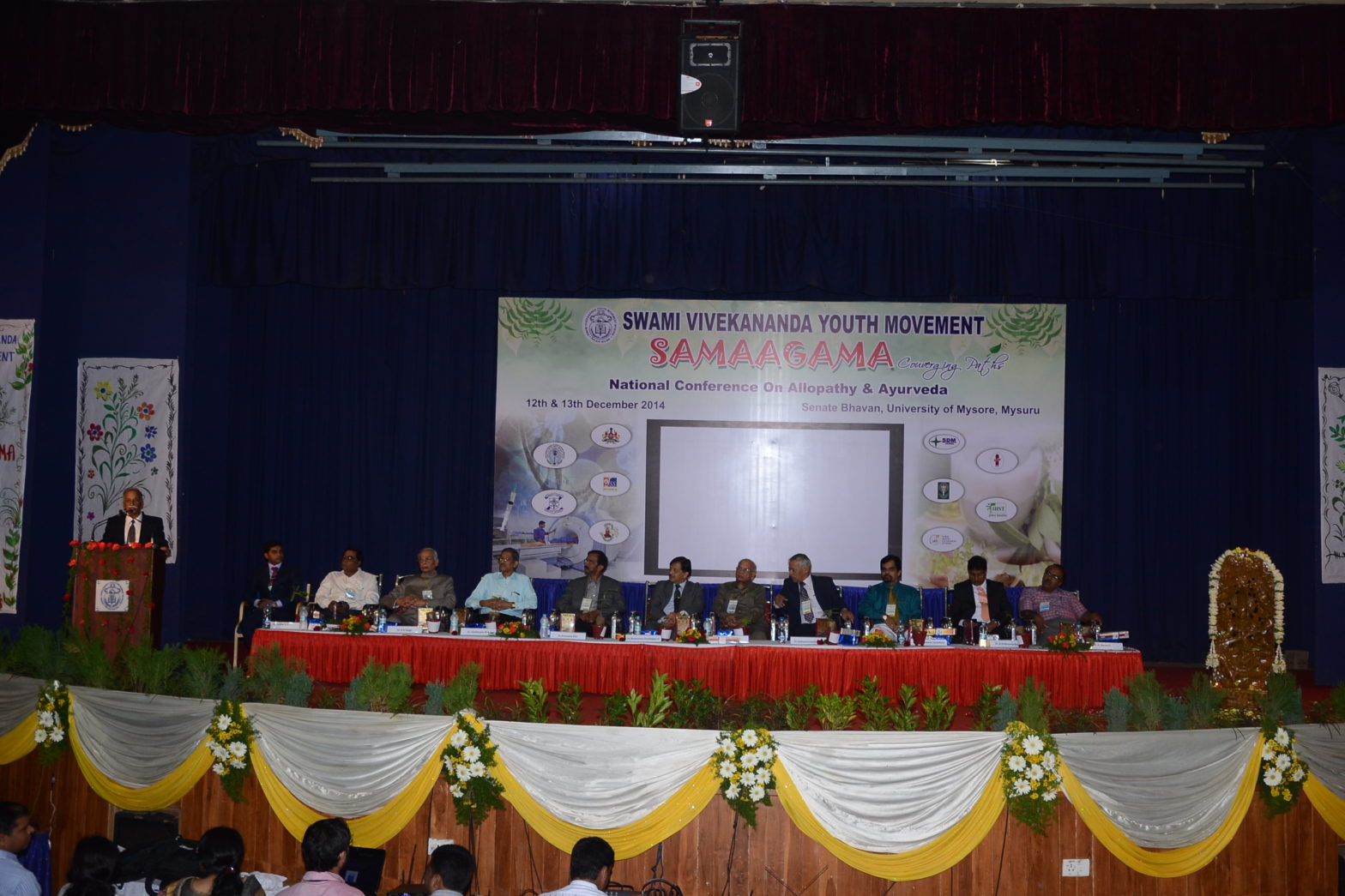
Heartiest congretulations to organizers of Samagama conference – “Swami Vivekananda Youth Movement” to organize such a nice conference.
Dr Alex Hankey, Research Director, SVYASA Bangaluru, togather with Mrs Purnima Datey presented a paper in an International Conference Held in City of Masoor. The topic “Decoding Ayurveda” atracted many of participants of conference.
Six Stages of Dosha Imbalance: Shadkriyakala
Shadkriyakala expresses
Six Stages of Dosha Imbalance: Shadkriyakala
Stages 1 & 2: Sanchaya &Pracopa–
Correspond to Hans Selye’s Stages of Stress Response: Adaptation and Maladaptation
Stages 3 & 4: Spreading & Localization
Concepts missing from Western Pathophysiology
Stages 5 & 6: Vyakta&Bheda– correspond to Claude Bernard’s Pathophysiology: Local Effects in Local Organs
Diseaseand itsFatal Consequences
Stages of Departure from Optimal Regulation
DECODING AYURVEDA
Ayurveda: the Central Role of Regulation in Health
Diabetes is a growing epidemic all over the world, particularly in India.According to the World health Organisation, India had over 61 million diabetes patients in 2010. The expected figure for 2030 is 80 million.
Swami Vivekananda Yoga Anusandhana Samsthana, Bangalore, started a nationwide ‘Stop Diabetes movement’ to eliminate diabetes. To support it, Arogya Yoga evam Rasahar Shodha Samiti, Bhopal has started a survey of diabetics. We hope that people will support this program. The form provided is an obesity survey. In the coming months we will provide Yoga & Rasahar to those in need who participate in this survey. So those suffering from multiple problems associated with diabetes, will get relief, and in future will not be dependent on medicines.
Purnima Datey Parul Kekre
9425027273 8989096659
Survey for Diabetes patients
Name ____________________________________________________